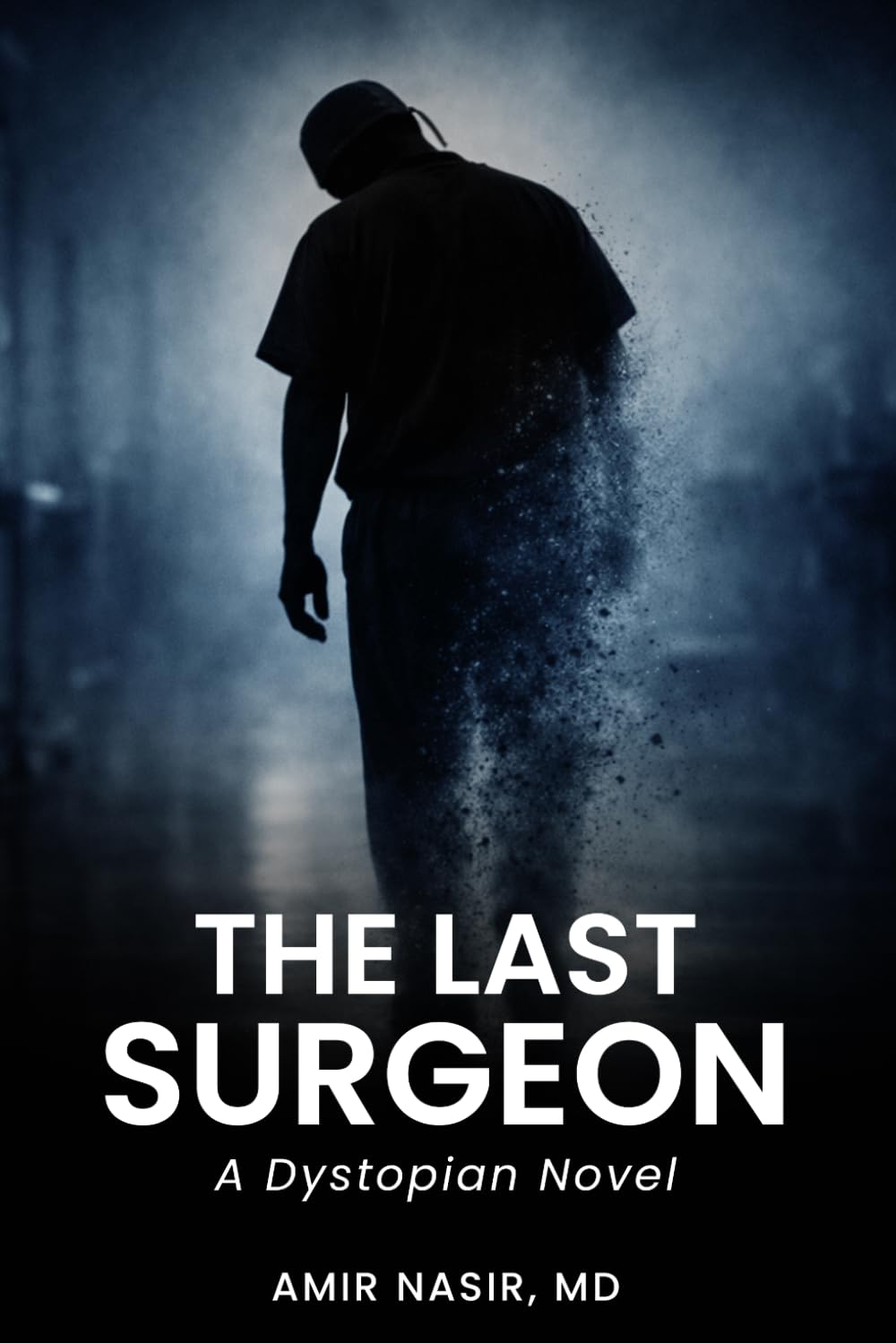

A near-future medical dystopia

The Last
Surgeon

What happens when healthcare improves—and the people who built it are no longer needed?

Dr. David Halpern has spent decades mastering surgery. As artificial intelligence and autonomous medical systems transform his hospital, he must confront a future in which surgery performed by a person has become the riskier choice.

Paperback and Kindle · By Amir Nasir, MD

The Last Surgeon: A Dystopian Novel by Amir Nasir, MD
MedicineArtificial intelligenceAutomationIdentity and purpose

The hospital works better.
David’s life’s work matters less.

David Halpern built his identity around the belief that skill, judgment, and compassion could never be automated.

The novel follows a technological transition that succeeds: waits shrink, costs fall, access expands, and complications become less common. At the same time, careers disappear, communities weaken, and people lose the work that once gave their lives structure and meaning.

If an institution serves patients better after replacing its people, what—if anything—has been lost?

Read the novel

Two kinds of technology reshape the hospital.

The story distinguishes the software that makes decisions from the machines that act in the physical world.

A

AI and software

Administrative and cognitive work

Documentation, coding, billing, scheduling, decision support, triage, diagnosis, telemedicine, and eventually management.

B

Robots and autonomous platforms

Physical and clinical work

Hospital deliveries, nursing assistance, operating-room support, anesthesia, and increasingly autonomous surgery.

Together, they allow the hospital to function with fewer and fewer human clinicians.

A plausible path from assistance to replacement.

The transformation is gradual. Each step solves a real problem—and makes the next step easier to accept.

  1. 01

    Paperwork leaves the doctor’s desk

    Administrative software takes over documentation, coding, billing, and scheduling. What first feels like relief soon becomes a demand for greater productivity.

  2. 02

    Clinical judgment moves into software

    Diagnostic systems, automated triage, and telemedicine give patients faster answers while physicians are pushed toward supervisory roles.

  3. 03

    Robots enter the wards and operating rooms

    Delivery units, nursing assistants, and operating-room robots take on physical work as staff shortages and financial pressure accelerate adoption.

  4. 04

    Autonomous systems begin operating

    Surgical platforms advance from simple procedures to more complex cases. Their measured outcomes and lower costs begin reshaping insurance decisions.

  5. 05

    Human-performed surgery becomes the exception

    Patients who still want human-performed surgery must seek it out. David becomes the last human clinician working in his hospital.

TheLastSurgeon.org

Surgery for humans
by humans.

In David’s world, this domain becomes a directory for patients searching for physicians who still perform procedures with little or no robotic assistance.

When his practice begins to fail, David advertises here and briefly finds patients willing to travel for human care. The site you are visiting is both the real home of the novel and a doorway into that fictional world.

Human Surgeon Directory

Minimal or no robotic assistance
Featured physician
David Halpern, MD
Availability
Rare and declining
Patient travel
Often hundreds of miles

A fictional interface inspired by the novel.

Would you still choose the human?

If an autonomous surgical system offered better measured outcomes, a faster recovery, and a lower bill, would you still choose a human surgeon?

Read the novel behind these questions—before the machines scrub in.

A near-future story about medicine, automation, and the people left behind when better systems redefine what—and who—is necessary.

Get the book