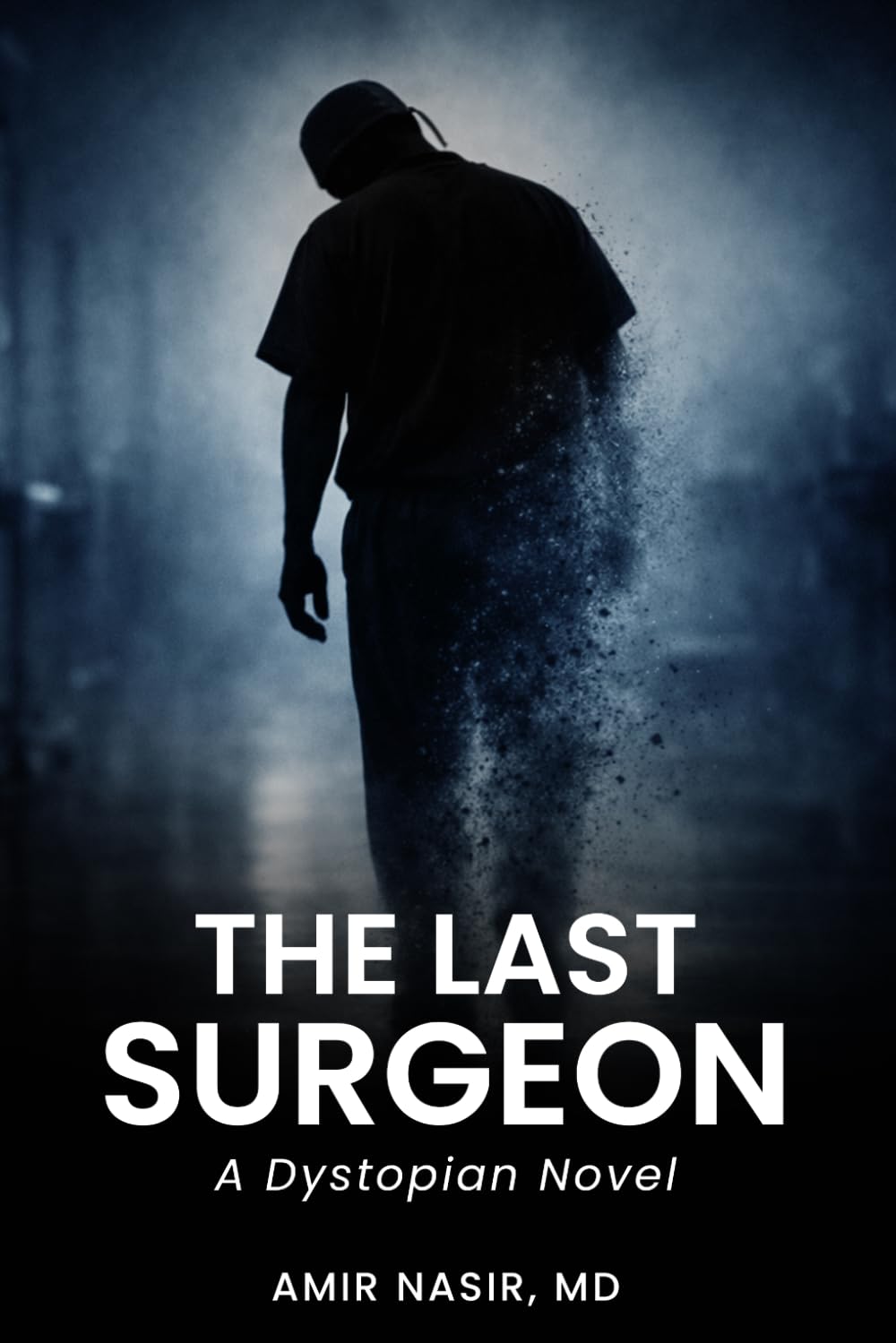
He still arrived fifteen minutes early.
The parking garage lights brightened automatically as his car—which he stubbornly chose to drive himself—descended. Rows of empty spaces illuminated in sequence and then dimmed again behind him. The hospital tower above was dark except for a few floors now leased to a diagnostics company that operated entirely at night, when electricity was cheaper and grid traffic was low. The surgical wing where he had spent most of his life had been repurposed years earlier. His small clinic occupied what used to be a billing department.
The doors unlocked when they recognized him. No security desk. No human staff. Just the faint smell of disinfectant and recycled air. Somewhere deeper in the building, a cleaning unit hummed, bumping softly against baseboards as it mapped the same corridors it had cleaned thousands of times before.
He hung his coat on the same hook he had used for the past several years. The hook was unnecessary now—most days no one else came in—but he kept the routine intact, as if the building might notice if he didn’t.
The waiting room lights came on half a second late, a small hesitation in the system that facilities had never bothered to fix. The chairs were arranged neatly around low tables that held nothing at all. No magazines. No intake forms. No pens chained to plastic stands. A cactus plant and a struggling fern sat on end tables, and photos of fields, an old farmhouse, and a dog running on a beach decorated the walls. The few patients who still came in completed their intake by mail before arrival or at his outdated check-in AI kiosk.
He stood there for a moment, listening.
In the corner, a robotic nursing unit remained docked to its charging port, humming quietly—a colleague that no longer needed direction, supervision, or conversation.
In the old days, hospitals were noisy—voices, phones, rolling carts, the distant percussion of doors opening and closing. Now the silence filled him with a deep, nameless melancholy.
Through the window he could see the street below. Traffic flowed in smooth, perfectly spaced streams, vehicles accelerating and braking in quiet coordination. Across the intersection, an IHOP started its morning operation with its lights off and no one inside. A delivery drone descended toward the pickup hatch, paused, then lifted again after dropping off a sealed bag.
He sometimes ate there between cases, wearing scrubs. He had watched the staff of servers shrink in number to be replaced with “HopBots.” Eating there now felt lonely and the only people that seemed to go there were young people glued to their phones or tapping at keyboards as they ate.
His office door still bore his name in brushed metal letters:
DAVID HALPERN, MD
GENERAL SURGERY
Facilities had asked whether they could remove the sign to standardize the hallway. He had said no. They had not asked again.
Inside, his office looked exactly as it had when he moved in. The shelves held textbooks thick enough to stop a bullet, their spines faded to soft pastels by sunlight. An anatomy atlas lay open on the corner of his desk where he had left it months earlier, a cross-section of the abdomen rendered in meticulous watercolor. He no longer needed to consult it.
The machines that performed most surgeries now referenced continuously updated anatomical models drawn from millions of scans, adjusting in real time for each patient’s unique anatomic idiosyncrasies.
His knowledge had once lived in his hands. Now it lived in servers.
The terminal on his desk woke as he sat down.
“Good morning, Dr. Halpern.”
The voice came from the ceiling speakers—warm, neutral, pitched carefully between masculine and feminine. It belonged to his practice management system, software that performed accounting, scheduling, regulatory compliance, and strategic forecasting with equal competence.
“You can just say good morning,” he said.
“Good morning,” came the reply.
A brief pause.
“No patients are scheduled for today.”
David nodded, and the camera noted the gesture.
“Any messages?”
“One priority notification. Would you like a summary or the full report?”
“Summary.”
Another small pause—not for processing, but because humans preferred it.
“Your medical malpractice carrier has issued a non-renewal notice effective the first of next month. Coverage for human-performed operative procedures will no longer be offered under their current risk model.”
He leaned back slowly, hands folded across his abdomen as if bracing for an impact that had already occurred.
“Shit,” he breathed.
“Is there an alternative provider?”
“I have identified two specialty insurers offering limited coverage. Both require higher premiums and preauthorizations for each procedure and impose significant liability caps. Based on your current case volume, projected costs would significantly exceed annual revenue.”
He sat there in silence.
He was not entirely surprised. For years insurers had quietly adjusted their policies as outcomes data accumulated—robotic systems produced fewer complications, fewer lawsuits, fewer unpredictable variables. Human surgeons had not been banned. They had slowly become risky and expensive.
“Would you like financial projections under a closure scenario?”
“Not yet.”
Outside, sunlight struck the glass of the opposite buildings, turning the intersection briefly into a field of reflected brightness. The autonomous traffic adjusted automatically, flows tightening, then loosening again as conditions changed.
He tried to remember the last time he had operated because he was the best option—not the ceremonial “human choice” for a patient insisting on it out of nostalgia or defiance.
The date hovered just beyond reach, like a word on the tip of his tongue.
“Any appointments this week?”
“One consultation request remains pending. The patient has not confirmed after reviewing estimated costs.”
Of course.
Human surgery was still available. It was just very rarely covered by insurance.
He stood and walked back into the waiting room, though there was nothing there to see. The chairs remained perfectly aligned. The air carried a faint citrus note from the cleaning solution the cost-conscious and omnipresent management preferred. On the far wall hung a framed photograph of the operating room teams from years ago—masked faces, arms folded, posture straight with the unconscious pride of people with purpose who believed in what they were doing.
Many had retrained, retired, or transitioned into oversight roles managing groups of surgical units they never touched. Most had simply left medicine altogether. Others started restaurants, day cares—anything to earn a living in the new economy.
A few had taken their own lives.
David believed that there was still space in medicine for human surgeons and that their skills and compassion were irreplaceable. The events of the past several years had tested that faith. He was no longer sure.
The photograph’s glass reflected his current position in the room, superimposing his older self over the team. For a moment he looked like a ghost standing among them.
From somewhere down the hall came the whir of the cleaning unit returning to its dock.
“Status,” he said quietly, not sure whether he meant the building, the practice, or himself.
The ceiling responded.
“Operational.”
He almost laughed.
Instead, he turned toward the window again. The traffic flowed without interruption. The restaurant across the street started serving customers. Above it all, aircraft rose and descended in silent, precise arcs, guided by systems that did not tire, hesitate, or make mistakes born of distraction or emotion.
The world was functioning beautifully.
He rested his hand on the back of one of the empty chairs, feeling the artificial leather warm slowly beneath his palm.
“Run the closure projections,” he said at last.
A brief pause.
“Understood.”
And a moment later, “Done.”
He did not bother to check or sit down again. He stood there in the empty room, listening to the low hum of the building.
Outside, another delivery drone lifted away from the IHOP, banked slightly, and vanished into the bright morning sky.
As he walked back to his car, the lights dimmed automatically behind him, conserving energy for spaces in use.
No one noticed him leave.